Online scams and circulating claims, examined one at a time
A short English section of a French-language publication. Each record states what was examined, on which pieces, and the date the finding was established.
Why the section is short
The full body of work is in French. What is translated here is the part that travels without a legal context: how an account intrusion is read from a session log, how an unlicensed gambling platform behaves at withdrawal, and why a plausible claim spreads faster than a checkable one.

Anything that turns on French or Swiss consumer law stays in French, because a translation of it would be misleading rather than merely incomplete.
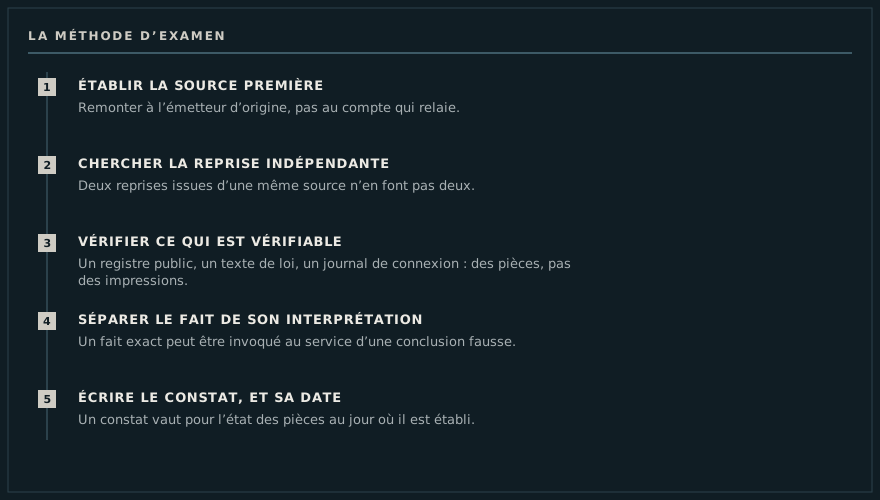
How a finding is established
Trace the claim to its first source rather than to the account relaying it. Look for a reprise that is genuinely independent – two reprises from one source are not two. Check what can actually be checked from outside: a public register, a statute, a session log, a timestamped record. Then separate the fact from what is being argued with it, and date the finding.
The French index is at whatthefake.ch, and the method is set out in full on the méthode page.
Why the checks travel and the law does not
A session log looks the same in every country. So does a public register, a wagering requirement, and the gap between what a page claims and what can be confirmed elsewhere. Those are procedures, and a procedure translates without losing anything.
Consumer law does not. Which recourse is open, in what order, and within what deadline depends entirely on where the buyer and the seller are, and a translated summary of French or Swiss rules would read as guidance while being wrong for most readers of it. That is the line drawn here: what is method is translated, what is jurisdiction stays where it applies.
What can be settled from outside, and what cannot
The constraint that shapes this section is narrow and worth stating plainly. A record is published when the deciding evidence can be reached by a reader who has no special access: an entry in a public register, the text of a statute, a page as it stood on a given date, a log the account holder can open themselves, an image whose place and time can be established.
A large share of what circulates fails that test, and not because it is false. Intent is one such case: whether an operator meant to withhold a payout, or merely applied a term nobody reads, cannot be read off anything available from outside. A private exchange is another, and so is any figure only one party holds – a complaint count, an internal deadline, a volume of blocked accounts. Where the deciding piece sits behind a party’s own door, the subject is left alone; anything published about it would be an inference wearing the clothes of a finding.
Reading a French record without French
Most of the material here is in French, and readers arriving from an English-language link land on it regularly. The structure is identical on every page, which makes it navigable before it is readable.
Four fixed positions carry the substance. A short block near the top states the finding in one sentence. A dated line beside it gives the day it was established. The side panel, always in the same corner, holds the list of pieces examined. And the headings are written as statements, so the outline read on its own already gives the argument in order. A machine translation keeps all four, because none of them depends on phrasing.
How to read a record
Each record opens with a finding and the date it was established, and the date matters as much as the finding. It bounds what is being claimed: this held, on this evidence, on that day. A platform can change its procedure a week later without anyone announcing it, and a piece published since can change a conclusion.
The evidence a record rests on is named in the side panel rather than left implied, so a reader can go and look at the same thing. Where nothing can be checked from outside, no record is published – an opinion with a date on it is still an opinion.
Questions fréquentes
How is a subject chosen?
A subject is taken up when something about it can be checked from outside: a public register, a statute, a timestamped record.
A widely shared claim with nothing checkable behind it produces an opinion, not a finding.
What does the date on each record mean?
It bounds the finding: it holds for the state of the evidence on that date, and a piece published since may change it.
Why is the English section so small?
Anything that turns on French or Swiss consumer law stays in French, because a translation would mislead rather than merely abbreviate.
Does this site recommend any service?
No. Nothing here is sponsored and no platform is recommended; the records describe methods and checks.