Record E-03 – Claims
Spotting a claim that will not hold, without judging how it feels
Three checks, none of which depend on judging how believable the story feels.

A claim spreads on plausibility and survives on evidence, and the two rarely arrive together. The stories that travel furthest are usually the ones that confirm something the reader already held, which is exactly when verification feels unnecessary.
Plausibility is not a signal
Some absurd stories are true. A man really did build steam rockets in his yard and fly one to prove the Earth was flat; the story read like satire and was not. Some entirely reasonable stories are invented, and they borrow a real context to do it. That is what makes them effective. Judging by how a claim feels sorts by the reader’s expectations, not by fact.
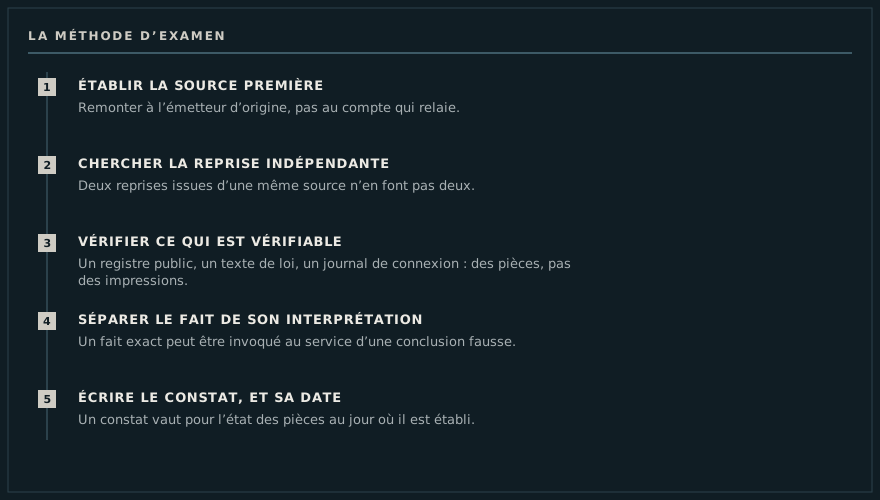
Find the first source, not the loudest one
Most false stories are not fabricated by the accounts sharing them; they are passed on in good faith. Tracing a claim back to the account that first published it usually takes a minute and settles more than any amount of argument about the content.
Count independent reprises, not mentions
Two reprises drawn from one origin are one source. Checking independence often reduces a dozen apparent confirmations to a single publication, and that single publication is then either credible or it is not.
Separate the fact from the argument
This is the part that is skipped most often. A fact can be accurate and still be invoked for a conclusion it does not support. Establishing that something happened and establishing what it demonstrates are two distinct operations, and a record that merges them is worth very little.
Two worked examples are published in French: one where the claim turned out to be exact although it read as a hoax, and one where it was false although the context was real.
When the claim is a number
A statistic travels better than a story, because it looks like it has already been checked. The three checks still apply, with one addition: the number has to be found inside the work it is attributed to. A figure quoted as coming from a study, an agency or a survey is often traceable to a document that contains a different figure, or contains it for a narrower population than the sentence quoting it suggests.
Two questions do most of the work. Who was counted – a survey of self-selected respondents and a register of recorded cases produce numbers that cannot be compared, however similar they look. And counted when: a figure from a single unusual year is routinely presented as a steady state. Neither question requires any expertise in the subject, only that the document be opened rather than cited.
When no first source can be found
Sometimes tracing back reaches nothing: a screenshot with no origin, an account quoting an account, a story that appears everywhere on one day and nowhere the day before. The conclusion available at that point is that the claim is unestablished, which is a different statement from saying it is false, and the difference is not a technicality.
Unestablished means the claim carries no weight and should not be repeated as if it did. It also means a document produced tomorrow could settle it either way. Recording the search itself – what was looked for, where, and on what date – is what makes the finding revisable instead of merely provisional. The French record on a protest camp said to have been burned turns on exactly this distinction.
Borrowed context
An effective false story almost never invents everything. It takes a real context – a long conflict, a genuine dispute, something already documented – and grafts on an episode that did not happen. The context does the work of credibility, and the grafted episode passes unexamined because it resembles what surrounds it.
Which is why "is this plausible?" is the wrong question. The narrower one works: this specific episode, who reported it first, and on what images taken where and when? When that answer is missing from the start, nothing else needs deciding.
Good faith is what makes it travel
The accounts that spread a false story are usually not the ones that made it. They pass it on because it confirms what they already held, and an expected claim is shared before it is checked. The mechanism has no political side; it works wherever an audience has an expectation. Reading mostly what confirms one's beliefs raises the chance of being shown more of it, which narrows the view of any subject further.
Both worked examples are published in French, and they point in opposite directions: a claim that read as a hoax and was exact, and one that read as reasonable and was false.